By Chambre d’hôtes Aya Team ·
A tajine is a pot before it is a dish, and the pot is the whole point. What separates the one cooked in a home kitchen from the one served to a coach party.
A tajine is first of all a piece of equipment: a shallow earthenware base with a tall conical lid. Steam rises into the cone, cools against the clay and runs back down onto the food. It is a machine for cooking slowly in very little liquid, which is exactly what you want in a mountain kitchen where water is carried and fuel is not wasted.
What actually makes it a good one
Three things, and none of them is a secret ingredient.
- Time. A real tajine sits for an hour and a half to two hours on a low flame. What is served fifteen minutes after ordering is a stew in a tajine-shaped bowl.
- Layering, not stirring. Onion and oil at the bottom, then the meat, then the vegetables banked up around the cone so the ones that need longest sit closest to the heat. It is never stirred — that is what would break the vegetables and let the steam out.
- Restraint with spice. Cumin, sweet paprika, ginger, turmeric, saffron if it is a special evening, plus salt and pepper. The point is the meat and the vegetables, not the spice cupboard.
The versions you will meet around here
In the Atlas, chicken with preserved lemon and olives is the everyday one — the preserved lemon does the work that a squeeze of fresh juice cannot, because it has been sitting in salt for a month. Lamb with prunes and almonds is the one that comes out for guests and for holidays. And kefta — meatballs in tomato with an egg cracked in at the end — is what gets made when children are eating.
Vegetable tajine is not an afterthought here. Carrot, potato, courgette, tomato and pepper banked around the cone, cooked in their own liquid, is a dish in its own right, and it is what a lot of families eat on ordinary evenings.
Bread instead of cutlery
It is eaten with khobz, torn and used to pinch from the section of the dish directly in front of you. You do not reach across. That convention is worth knowing before somebody has to tell you.
Why we mention any of this
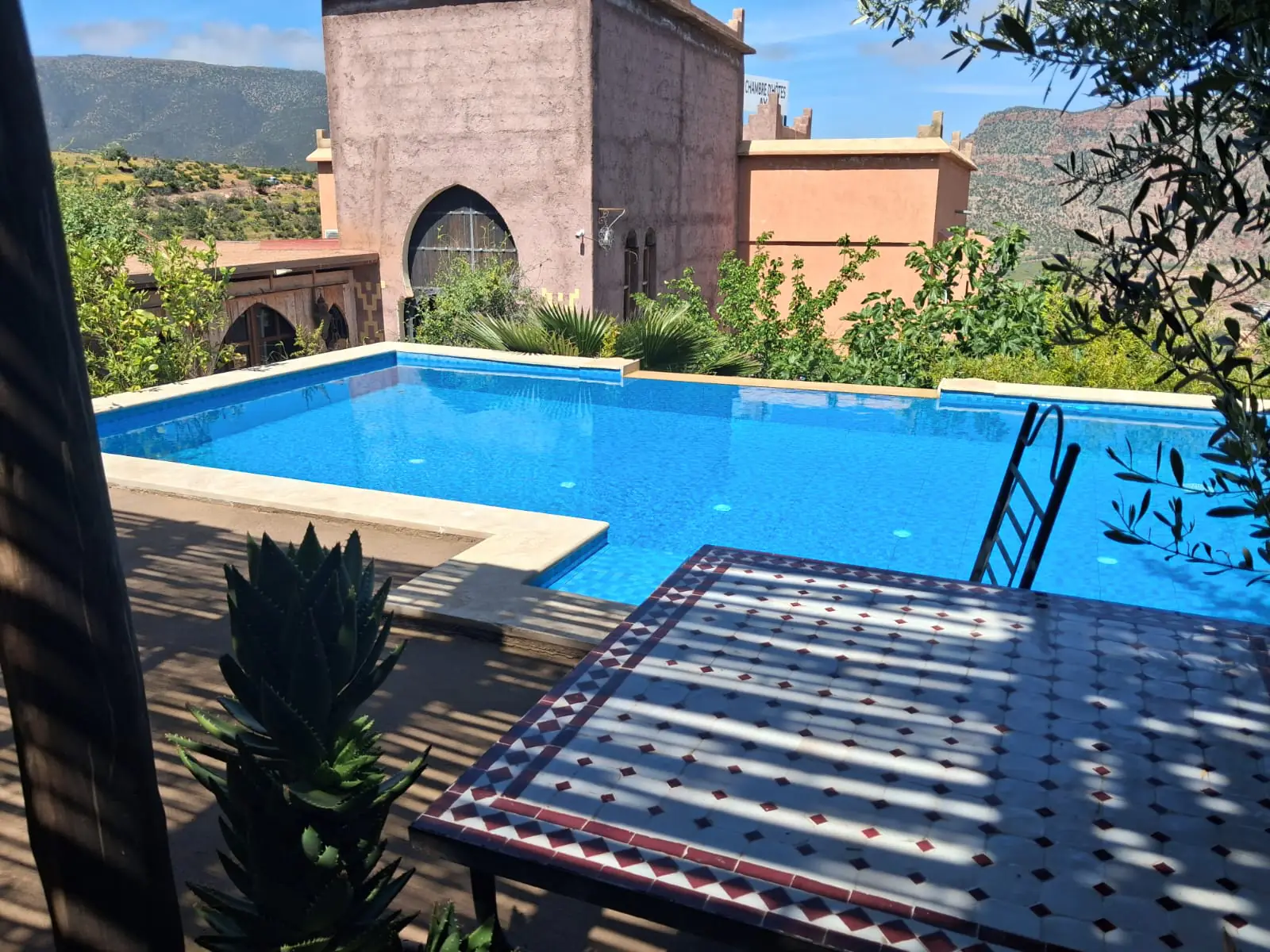
Because the difference between a tajine cooked for you and a tajine cooked for a hundred covers is enormous, and it is the single thing guests write to us about afterwards more than the pool or the view. Ours is cooked in the kitchen here, started in the afternoon for the evening. It is 120 MAD a person with a starter, a dessert and water — tell us when you book so we can shop for it that morning.
The same goes for breakfast, which is included: the msemmen and baghrir are made on the pan that morning, and the amlou and the jam are made here rather than bought.
Planning your trip to Ouzoud?
Book directly with us on WhatsApp — no commission, and you are talking to the owner.